One of the coolest things about TIFF is being able to see a film before, and in some cases LONG before it's released to the general public. Midnight Madness 2009 selection Solomon Kane is one of these - it's only seeing limited release in late September if IMDB is to be believed - and last years selection The Day is another.
The Day, however, is unique in that it's got the chokeslamming, powerbombing muscle of the WWE marketing machine behind it. It's being released on the 28th of August and Vince McMahon and his cadre of publicists ran a special sneak preview of the post-apocalyptic siege film with several wrestlers (don't worry, no cameos from The Big Show in this film) in attendance. Check it out!
With this in mind, don't forget to pick up your TIFF Midnight Madness passes, so when your friends are lining up like schlubs to see these films next year, you'll be able to lord over them the fact that you've seen them all already. And isn't that what friendship is all about?
TIFF Midnight Madness passes for all ten films in the 2012 schedule are SOLD OUT, but you can still pick up single tickets to films in the Midnight Madness Programme (and others) starting on Sept 1.
It's been a while since I gave a true update here at Fights Gone By, rest assured that this is simply due to my being busy and not my abandonment of my blog. To update you on what I've been up to, as always it's been writing and training for much of the last few weeks. I did, however, get the chance to travel into London to see three events at the 2012 Olympics; boxing, greco-roman wrestling, and weightlifting. I must say that despite having never been someone with a great sense of patriotism, I was truly proud of how well Britain pulled the Olympics off, Beijing was certainly a tough show to follow and we managed not to embarrass ourselves at all (minus the flag incident)!
As someone who has only recently started weight training seriously (embarrassingly late for someone so passionate about combat sports) I found myself getting more excited about the Olympic weightlifting than I ever could have imagined. Having won my seats in a competition (very good seats, six rows in front of Amir Khan!) I had low expectations for what turned out to be one of the most dramatic live events I've ever been to. I had no idea that so much strategy was involved. The boxing was also excellent, I got to see some cracking young talents from the Dominican Republic, Thailand, Kazhakstan, Mongolia and even the tiny Seychelle Islands.
My training schedule has remained much the same, training every day except for Sunday and then pacing around all day on Sunday complaining that I've got too much energy and that I'm bored. My Brazilian Jiu Jitsu is finally feeling a little sharper after training twice a week for the last couple of months. I am no longer feeling so fatigued by rolling and I am hoping to step it up to three or four sessions a week in the coming months, eventually hoping to immerse myself in rolling every day, but that's a little way off yet. I did injure myself this week, crunching my ankle and knee under my weight and the weight of a training partner, but I managed to ice it pretty quickly and take good care of it and have been able to train and teach for the last couple of days. Hopefully I will be back to rolling on Wednesday but it's certainly given me time to catch up with blogging and writing Elementary Striking!
Today I have been running through the photo list for Elementary Striking, looking for ways to keep the book short but somehow comprehensive - it's a tough ask. I have also been uploading three pieces a week to Bloody Elbow and have finally got into a sort of pattern. My first piece of the week is normally a "Finish of the Week" from kickboxing, boxing or MMA. The other two pieces a week are pre and post fight analysis. I'll wrap this update up here because my keyboard has just broken and is only allowing me to type lower case letters if I turn the caps lock on and hold shift! I will keep you all updated but Elementary Striking should be out by the end of September.
It's been a while since I've updated because I've been mega busy. I will check in with a full update of everything I'm up to later in the week but for now, here is a BIG piece I wrote over at Bloody Elbow.
Cheers,
Jack
Ahead of Dan Henderson's meeting with Jon Jones, I want to take a detailed look at what we are more than likely to see in the bout. Henderson's way to win is obvious to all - crowd Jones and catch him with a right hook or straight. Jones' ways to win are what we will look at in this article. While we will keep Jones in mind throughout this piece, most of the strategies discussed can be used by just about anyone against a dangerous right hand puncher like Henderson.
Dan Henderson has had one of the greatest career resurgences in mixed martial arts history, coming back from the middle of the middleweight mix to stop some huge names in the light heavyweight division. What many people fail to realise is that Henderson's career revival has been less to do with him and more to do with his opposition. Henderson hasn't changed; the right hand has always been there, as have the other Henderson trademarks such as the crucifix off of the single leg defence, punching on the guard pass etc - he simply hit a streak of opponents who were vastly overconfident in their striking or lacked the fight IQ to give Henderson the respect he deserved.
Mauricio Rua showed amply what a misplaced belief in speed and boxing ability does against a dangerous puncher such as Dan Henderson. Fedor Emelienenko also lost to Henderson not as much through Henderson forcing his game on the Last Emperor, but through Fedor rushing Henderson overconfidently and giving Henderson the hole through which to connect his power. Rafael Feijao is another excellent example of an overconfident striker - as with Murillo Rua, people are convinced that his striking must be great based on his training partners, and in truth he is even more limited to his right hand than Henderson is on the feet. You cannot make a mistake against Dan Henderson because no-one can change the direction of a fight with one punch as well as Hendo. Unlike most opponents it is not a case of if a mistake will be capitalised on, Dan Henderson always capitalises on mistakes.
What can't be denied is Henderson's ability to knock out just about any man alive. If any of Henderson's opponents fail to make specific preparations for Henderson and believe that the polish on their striking fundamentals will protect them from him they are very much mistaken. Striking IQ is what is needed to defeat Henderson on the feet, and that is something that Mauricio Ruanever had and that Fedor Emelianenko abandoned in 2009.
To summarize the strategies in today's Judo Chop they will be:
- Circling Away with Punches
- Outside Low Kicks
- The Jab
Circling Away with Punches
Henderson's power is all in his right hand; he stands almost side on and cannot throw a strong jab or a left hook out of his stance. I'm sure many will remember the left hook that Henderson knocked Wanderlei Silva out with, but this was thrown AFTER using his right hand to square up - while Wanderlei was standing and trading with Henderson.
When one fights an opponent who is side on it is advisable to circle away from their rear hand, when one fights an opponent who is square on it is advisable to circle away from their lead hand. A square fighter may have a powerful right hand, but it will be an arm punch, and the same applies for the lead hand of a side on fighter such as Henderson.
Mechanics simply dictate that the side with less potential to swing from the hips will have less power. This rule almost always rings true. Felix Trinidad, Quinton Jackson, Paul Daley - all in love with their left hook, but you could know that within a moment of engaging them because they stand so square on. Dan Henderson, Gene Fullmer, Rocky Marciano, Butterbean, Rashad Evans - all stand / stood side on because they are / were in love with their rear hand.
It's not hard to note someone's strong punch even if you've never met them before, it's not even especially hard to circle away from it. What is hard is convincing experienced brawlers like Mauricio Rua or Rafael Feijao that they need to. Career longevity depends not on fancy footwork, but the ability to move away from an opponent's power consistently.
Notice in this still from the opening seconds of Henderson's bout with Jake Shields just how side on Henderson (back to the camera) is. His right hand is forward to somewhat disguise how side on he is, but a quick look at his right hip will reveal that it is pointing almost back towards the camera. When Henderson lunges onto his lead leg he swings his right hip all the way through and allows his shoulder to follow and his fist to complete the motion after everything else. This is where his incredible punching power comes from, not his musculature - which is hardly uncommon at light heavyweight and middleweight. You will notice however that Henderson's left hip is so far forward that he cannot rotate it forward any more to put power on a jab or lead hook.
The disciplined fighter will circle around towards Henderson's lead side, because anything Henderson throws from his left will be an arm punch. Henderson could attempt to turn his hips to the front to allow him to turn them back in a hook but this would be incredibly slow in an area of the fight game where split seconds count. Instead, Shield's threw jabs while circling into Henderson's right hand. This was, of course, foolish - yet Feijao and Shogun circled the same way and got beaten up just the same.
Dan Henderson's side on stance greatly inhibits his ability to pivot or stop his opponents from circling to his left side. For lack of a better diagram online I will use two paint images I used way back in February to describe angles on Head Kick Legend. These diagrams represent a top down look at two fighters.
Standing in front of an opponent is a 50 / 50 proposition. Both men can connect just as easily as each other and more often than not a man with a granite chin and a big punch will win here. This is Dan Henderson's world and no amount of sparring, training on the pads or hitting the heavy bag will take away the tit-for-tat dynamic of head on exchanges. Good striking is about not getting hit, therefore head to head exchanges are not good striking.
In an ideal world, this is what one wants to do against a stronger, tougher opponent. The top fighter has circled towards the bottom fighter's weaker, leading side. Notice how far the bottom fighter's right hand would have to travel to connect - a distance which it is impossible to cover with any power or weight behind the punch. Meanwhile the top fighter is in perfect position to throw both of his hands on target. Punches may also be executed during the step to the angle - such as the left hooks that we looked at earlier in the week from Ray Robinson and Joe Walcott.
In reality a fighter will almost never get a perfect angle, because the opponent will turn to face the fighter who has cut the angle, but this is just as much of a victory - because while the opponent is turning, he is essentially on one leg. No-one in the world can generate their full power while turning - it is simply mechanically impossible. After claiming a slight angle, a fighter may charge in with a flurry that looks like an ugly bum rush, but because the opponent is turning it is not a 50/50 exchange at all. Here is a look at Lyoto Machida taking an angle on Thiago Silva, then running in as Silva turns to face him.
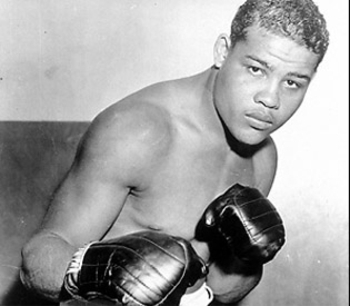
I have been promising to write some detailed pieces on Joe Louis for some time. Very few fighters in any discipline have stylistically affected my own sparring, training and teaching as much as Joe Louis has. Why did I fall in love with Louis' style? I was interested in knockouts, yes, but I was interested in fighters who knocked their opponents out, without getting hurt on the way. Louis' style - though it is called textbook by many great coaches including Freddie Roach - is still not utilized today to the same effect Louis utilized it at his best. Boxing has, no doubt, changed - but the rise of Mixed Martial Arts where gloves cannot simply be held to one's cheeks to shield blows has drawn more attention to the subtle techniques that made Louis great such as the dipping jab.
The base of Louis' style was his crouch, which has sometimes been referred to as the Blackburn crouch, a name which I very much like. Jack Blackburn is an incredibly interesting figure in the history of boxing, having run a moderately successful career with almost 150 fights he wound up serving a prison sentence from 1909 - 1913 for murder. Blackburn was no doubt a controversial figure, which made the decision by Louis' early management to put Louis in the hands of Blackburn even more curious. Their main concern was to make Louis appear meek, mild mannered, and respectful - the anti Jack Johnson - yet a man who served time for murder was his closest confident. Blackburn not only nurtured Joe Louis, but abandoned his older, less athletic prospect, Jersey Joe Walcott, to do so.
Later in Blackburn's life, a young Sugar Ray Robinson began to attend Joe Louis' training camps and was reportedly the only one willing to go fishing on the lake with Blackburn despite having no interest in it. In his autobiography, Robinson recounts with a moving enthusiasm, how he used to accompany Jack Blackburn just to hear Blackburn talk about boxing. With Joe Louis, Jersey Joe Walcott and Ray Robinson all under the direct influence of Blackburn, it is arguable that his training produced the savviest stable of fighters of any coach to date!
One common feature of these three Blackburn fighters is their stance. While Joe Louis shuffled back and forth, Sugar Ray Robinson danced to his left all night, and Jersey Joe Walcott stepped across himself with either leg and turned his back multiple times in a fight, they all engaged in a very similar, technically excellent stance. Notice in these two images of Louis (one seems to be southpaw, I'm unsure if it is mirrored, Louis rarely switched stances) how he carries his hips turned back - making his rear hand's path a long one but placing him almost sideways on. Additionally, he is bent forward at the waist - taking his head off of the centreline and making it very hard to reach with right hands. This means that his lead hand may be held lower - making it harder to see coming and adding power to it by linking it's motion more fully with the movement of his body. The tendency in many fighters who fight with their hands high is to jab from the arm alone - Louis, Robinson and Walcott all carried their lead and low and stepped in with their weight behind their jab.
Notice also that Louis' rear hand is not positioned up by his chin or cocked to punch, it is loose and free, ready to parry or check the opponent's lead hand. This is not laziness in the photos - Louis' rear hand was genuinely that relaxed, but it rarely stayed still for long. The truth of the Blackburn crouch is that offense from it is performed mainly with a stiff jab - but this is led by an active, adaptive right hand. Louis would parry his opponents jabs, looking for openings, or cover their lead hand and step in behind a combination - or be ready to block inside a lead hook and tie his opponent up. Take a look at the first few minutes of Louis' match with Nathan Mann.
You will notice that Louis stifles Mann's attempts to "establishing the jab" in the opening minutes- dipping under it, or parrying it, or performing both for safety's sake. This match has an uncharacteristically slow start from Louis - who gets clipped several times, but as he warms up it's a vintage performance from the Brown Bomber. After the 2:00 mark, Louis really finds his stride - looking comfortable and even nonchalant as he walks Mann down. By placing the body almost on a knife edge, with the lead shoulder being the closest point to the opponent, the Blackburn crouch greatly increases the skill in jabbing exchanges - taking away the need for great speed. You will notice that Louis' feet are not swift, in fact he is quite a cumbersome fellow, but he has no trouble after the 2 minute mark in connecting his jab. Walking Mann down until Mann attempts an attack, at which point Louis parries and simultaneously delivers his own jab. This is the bread and butter of Louis' style and the primary counter afforded by his stance.
Here is a nice example of Louis on offense as he walks down Max Schmeling in their rematch. Louis plods towards the German who is stepping off to re-establish position elsewhere in the ring, then pounces on him with a hard jab that comes unexpectedly soon. While it is a fairly fast jab, it is important to the remember that jabs with the bodyweight behind them, as with Louis', are often slower than "snap jabs" performed with the arm alone, and yet Louis connects this weighted jab completely by surprise. This is largely due to timing and the fact that Louis almost never left his stance - he was always in position to push off of his back leg and drive in with a lead.
Here, again in the second meeting with Schmeling, Louis uses his jab to enter the pocket. Notice that the Blackburn style, and Louis' style, is all about controlling with the right hand - rather than blindly firing the left with the right up by the chin as a guard. Louis covers Schmeling's lead and steps in with his own jab. His head is not as far offline as against Mann in this match, and that is largely to do with his following both jabs on Schmeling with a left hook, for which is it necessary to have the shoulders over the hips, rather than dipping as in Louis' usual jab.
The most important point of note in the Blackburn crouch is that the head may be taken out of the line of fire with a dip at the waist, and not with side to side head movement. In almost all of Louis' fights, he does not slip to his lead side - only to his rear side, in varying degrees of a duck. This movement comes from both the waist bending and the legs crouching. When a jab or lead hook is ducked, a counter may be fired with the right or left hand, and when a right hand is ducked, it is simply underhooked and a clinch is established.
Louis' style is often attributed to natural skill, but in fact he was a clumsy gentleman with a big punch who was turned into one of the finest boxers in history. The Blackburn crouch, whose defense requires none of the split second timing necessary to identify a punch and slip to the appropriate side, is absolutely a viable option for almost anyone. Side on stances are not the fashion at the moment in boxing, which very much moves in trends, but it is very interesting that men such as Floyd Mayweather and Bernard Hopkins can have such great affect by using so called "old timer" techniques in a sport which pretends it has evolved past greats like Joe Louis and Ray Robinson.
To witness some of Louis' excellent ducks and counters, and for a taste of some of the beautiful technique to come in this series, take a look at this excellent highlight by Reznick. Notice that when finishing, Louis can get a little wild - he is certainly not perfect, but his defense and counters are top notch and all depend on varying degrees of a duck to his right. Louis almost never slips to his left because it is simply not the nature of his stance. My personal favorite and a lead to counter that I enjoy utilizing a lot comes at around 2:30.
To learn more about Joe Louis, stay tuned on Fights Gone By, also pick up my Advanced Striking ebook if you haven't already - which contains 70 techniques from 20 great strikers, around 15 of which came from Louis, Walcott and Robinson alone. The Blackburn crouch is extremely important to my personal striking philosophy and so will be covered in great detail in my upcoming Kindle book, Elementary Striking.
Can you believe that it's been six months since I began this little blog? In that time Fights Gone By has gone from dragging in 50 hits on it's first day, to 200 at the end of the week and now thousands a day! I am so glad that my analysis, views and coaching are appreciated by fans, fighters and even coaches around the world.
I have been terribly slap dash in updating my blog since my return to writing at the start of June, and for that I can only apologize. While I did get the third installment of the Southpaw Guide up, I haven't done much else, even in the way of telling people what I'm doing at the moment!
To bring my supporters up to date, I have been continuing my commitment to Bloody Elbow with my MMA analysis, which is going extremely well! I have long contended that fight fans would much appreciate actual analysis and breakdowns more than gossip, and the incredible reception of my pieces at BE so far (many of which have produced the most traffic for the week that they have been published) has simply served to prove this. I have also been increasing my amount of training days - teaching more striking technique and making a concerted effort to improve my fledgling Brazilian Jiu Jitsu game (developing a passion for the X-Guard in the process). While I am not teaching striking full time yet, I am able to focus almost exclusively on writing and training - and that truly is my dream existence.
Another activity I have been engaging in, which I have only mentioned briefly up until now, is writing a guide to the techniques that I teach to my students and training partners, and which have allowed me - as a nonathletic individual - to hang with the finest karateka, kickboxers and MMA fighters I've met and which I have accumulated from kickboxing, boxing, MMA, Muay Thai and karate coaches everywhere I have traveled. As opposed to my first book, Advanced Striking, which was based on case studies, this one will be about many of the principles that I mention throughout my articles. The Pattern of Offense, moving to and striking from angles, Open and Closed Guard, Punch and Clutch, and defensive tie ups will all be covered in detail.
The idea of the book (the working title of which is Elementary Striking) is to teach the basics of striking martial arts, and the basic principles and strategies which govern striking as a science and art. A great many of the books out there charge readers $50 to learn the basic mechanical movements of striking and offer little to nothing in the way of strategy. My second book will be released exclusively for Kindle on Amazon and won't cost more than $10. It is my hope that I can produce a work which becomes as valuable to the fighting community as Dempsey's Championship Fighting or Edwin Haislet's Boxing. While that is a lofty aim, I will be more than happy if my second book can produce not only competent strikers, but ones who understand the hows and whys of not getting hit and landing clean blows.
Meanwhile I will have a short series coming to Fights Gone By which I have wanted to write for some time. This series will be an analysis of Joe Louis who I (and many others) consider to be the finest technical boxer to date.
With all of these things in works it may be a week or so before you start to see pieces appear on Fights Gone By, but after that they should be coming thick and fast! ;)
P.S: Look out for my new logo which is also coming soon!
In monday's article I spent almost 4000 words searching for a chink in Anderson Silva's armour, and came to the conclusion that the holes in Silva's game certainly require a unique skill set to exploit. I won't say a rounded skill set because almost no-one at middleweight has one of those; which is in no small part responsible for Anderson's incredible success and consistency. It seems that one needs a world class ground game or the threat of world class takedowns to force Anderson to square up to sprawl, then - while continuing to threaten with the takedown - power strikes must be mixed in. I also demonstrated that few people have ever had that much success (at least in the octagon) in closing the distance if they are in the opposite stance to Silva (or Open Guard).
Today, we will examine in more detail the technique that Chael Sonnen used to close the distance and hurt Silva numerous times throughout their bout, the rear straight. Of course, Silva had fought competent rear hand punchers before - Dan Henderson and Vitor Belfort most notably. Dan Henderson is an orthodox fighter and was therefore not able to find much home for his tremendous right hand due to the enormous distance in Open Guard with Silva, furthermore Henderson throws his rear hand in a looping swing, and is thus already handicapped in the reach of his punch. Vitor Belfort, meanwhile, despite taking Silva down off of a kick at the start of their fight, was not much threat on the ground (having done next to nothing there in MMA despite his sterling ADCC record) and Silva felt no need to square his hips up or fight a takedown defence based game. Chael Sonnen was able to nail Silva so routinely with strikes because Silva's hands were low and hips were squared to defend the shot. It was not magic, just effective variation of offence.
The truth is that Anderson isn't half the counter fighter that he is against strikers when he is squared up and prepared to sprawl. He cannot shoulder roll or put much power in his rear hand, and if more grapplers were wiling to swing punches at him they would not only be capable of landing strikes more than they expected, but also be awarded with takedown opportunities that wouldn't otherwise exist.
Chael Sonnen's use of the rear hand straight to tie up of, shoot off of, and just deal damage with is something I have been calling for more grapplers to use for a long time. The old method of jab and shoot is enormously outdated, and not technically sound, it only succeeded because of the element of surprise and an enormous disparity in wrestling abilities between competitors. Tying up or shooting off of the rear hand is an excellent way of securing a takedown or a jarring right hand, and if more grapplers opted to utilize it we would see a rise in the number of knockouts secured by grapplers and in the number of successful takedowns.
Some of Silva's suspected weaknesses are discussed much more than others - the debate over Silva's submission defense, for instance, has been rehashed a thousand times. This is due to his two most notable losses coming by submission to Japanese journeymen. More recently, however, Silva has proven by submitting Travis Lutter that he can hang with Jiu Jitsu black belts on the ground, and while the idea of submitting Silva should not be ruled out, he is certainly not going to be submitted by a low quality submission fighter such as Chael Sonnen or Yushin Okami.
If Silva has proven himself such a difficult man to submit, why has the submission defense question been so overplayed? Almost entirely because most in the media are afraid to analyze the holes in the man's stand up, and indeed many in the community would not know how to begin doing so. The two losses on Anderson's record which came inside the distance (and weren't caused by a DQ) are very easy to grab on to. He was finished both times by submission, therefore his submission defense must be the problem. This logic is not suitable for analyzing the areas in which Anderson can be exploited. To really understand and pinpoint the loopholes in Silva's remarkable game it is necessary to actually analyze his fights and the evoluton of his style, instead of focusing attention on the numbers on his record.
Anderson Silva is an amazing fighter, one of the greatest of all time, and the fact that in so many bouts in the UFC we have only seen flashes of vulnerability only makes the task of analyzing his game objectively even harder. To understand Anderson's vulnerabilities we must go back to the beginnings of his career, when he was taken down often, and analyze how he changed this. We will discuss through this article how it was Anderson's change in tactics, not developments in his wrestling ability, that enabled Silva to keep fights standing against elite grapplers where before he was being taken down by journeymen. Silva's game has changed significantly over the years to be based off of a few strategic choices and moves.
We will not dwell on the submission defense argument in any great depth but rather on Anderson Silva's: